

Self-trust can feel like a big thing. A solid thing. Something we either have or do not have. We often imagine it as a clear inner voice that speaks with certainty, never wavers, and always knows exactly what to do.
When we picture a woman who trusts herself, we may imagine someone who makes decisions easily, sets boundaries without spiralling, knows what she wants, follows her instincts, and does not ask ten people for reassurance before choosing. She seems steady, confident, and sure.
But for many women, self-trust does not begin that way. Especially if you have spent years overriding yourself, minimising your needs, doubting your feelings, keeping the peace, or seeking external approval before allowing yourself to choose what feels true.
Self-trust is not usually rebuilt in one brave leap. More often, it returns through tiny choices. One honest pause. One small no. One small yes. One moment where you notice what is true and choose not to abandon it.
Why self-trust gets quiet
Most women are not born disconnected from themselves. A child often knows what she likes, what she does not like, when she is tired, when she is full, when she wants comfort, when she wants to move, and when something feels unfair. But over time, many women learn to override these signals.
They may be taught not to be too much, not to be difficult, not to disappoint people, not to make a scene, not to need too much, not to say what they really feel, and not to inconvenience others. They may learn that being nice, easy, strong, grateful, or agreeable is safer than being honest.
If you receive enough messages that your inner signals are inconvenient, dramatic, selfish, or wrong, you may learn to check outside yourself before you listen within. You may become very good at asking what others need, what others will think, what is expected, what keeps the peace, or what a “good” woman would do.
Slowly, the question “What feels true for me?” becomes harder to access. That does not mean your inner voice is gone. It may simply mean it has been quiet for a long time and needs safety, patience, and practice to become audible again.
Self-trust grows through evidence
If you do not trust yourself right now, please do not turn that into another reason to be hard on yourself. Self-trust is not created by demanding that you suddenly become confident. It grows through evidence.
That evidence is often small and repeated. You notice a need and respond to it. You say no and survive the discomfort. You make a choice and learn from it. You listen to your body before you reach collapse. You tell yourself the truth, even quietly. You come back after abandoning yourself, instead of using that moment as proof that you have failed.
Every tiny choice becomes a message. I can hear myself. I can respond to myself. I can repair with myself. I can learn. I can choose again. This is how self-trust becomes less of an idea and more of a relationship.
Start with the small yes and the small no
If you are rebuilding self-trust, begin by listening for the small yes and the small no. These may not arrive as dramatic certainty. They may show up as subtle signals in your body and energy.
A small yes might feel like softening, relief, curiosity, warmth, expansion, interest, or a sense of quiet aliveness. A small no might feel like tightening, heaviness, dread, irritation, contraction, tiredness, or a quiet sense of “not this.”
These signals are not always instructions to act immediately. They are information. They are invitations to listen. Your body may say no to a social event, and instead of automatically agreeing, you pause. Your curiosity may say yes to a creative idea, and instead of dismissing it, you write it down. Your energy may say no to a conversation happening right now, and you ask to come back to it later.
This is how you begin rebuilding the bridge between inner knowing and outer action.
Clarity often follows permission
Many women wait for clarity before they give themselves permission. They think they need to know exactly what they want before they take a step. They need to be sure before they say no. They need to justify a feeling before they honour it. They need everyone else to understand before they are allowed to choose.
But sometimes clarity does not arrive until after you create enough permission to listen. If your inner world has been ignored for a long time, it may not speak in full sentences immediately. It may begin with discomfort, resentment, longing, exhaustion, curiosity, or a sense that something does not fit anymore.
These signals may not give you the entire map, but they may show you the next step. Clarity is often less like lightning and more like a path appearing one small choice at a time.
The fear of getting it wrong
One of the biggest barriers to self-trust is the fear of making the wrong choice. You may worry that you will regret it, disappoint someone, be selfish, misread yourself, choose incorrectly, or change your mind later.
If you have been criticised, dismissed, blamed, or made responsible for other people’s emotions, choosing for yourself can feel high-risk. You may feel like every decision has to be perfect before you are allowed to make it.
But self-trust is not the belief that you will always get everything right. Self-trust is knowing that you can stay with yourself through the outcome. You can choose, learn, repair, adjust, change direction, and hold yourself with kindness if something does not unfold the way you hoped.
Self-trust does not require perfection. It requires relationship.
Your body may need to trust slowly
If you have a history of ignoring your limits, your body may not immediately believe you when you say things are changing. If you have promised yourself rest and then pushed through again, your body may need repetition. If you have said you will honour your needs and then abandoned them to keep the peace, your body may need proof.
This is not a reason to shame yourself. It is a reason to begin gently. Do not demand that your body trust you because you have decided it should. Show it, in small ways, consistently.
Drink water when you notice thirst. Pause when the automatic yes begins to rise. Rest before collapse when you can. Tell the truth in one low-risk place. Choose the food, the walk, the quiet, the conversation, the boundary, or the support that actually feels right.
Each small act of listening becomes a repair.
Self-trust and support can coexist
Sometimes women think self-trust means never needing input. But trusting yourself does not mean isolating yourself. It does not mean never asking for help, never seeking perspective, or making every decision alone.
Healthy support can strengthen self-trust when it helps you hear yourself more clearly rather than handing your authority away. There is a difference between seeking support and outsourcing your truth.
Seeking support might sound like, “Can you help me reflect on what I am noticing?” or “I need a safe space to hear myself think.” Outsourcing your truth sounds more like, “Tell me what to do,” or “Tell me whether I am allowed to feel this.”
You are allowed to receive support. You are also allowed to remain the authority on your own inner world.
Tiny choices that rebuild self-trust
Self-trust grows through ordinary moments. It may look like choosing what you actually want for lunch, pausing before committing, admitting you are tired, noticing when your body tightens, changing your mind without attacking yourself, asking for clarification instead of pretending you understand, or saying, “I need time to think.”
These choices may seem small, but they are not insignificant. They teach your system that your inner signals matter. They help the woman inside you learn, “I will not be ignored this time.”
This week, choose one tiny trustworthy action each day. Not a dramatic life change. Not a perfect routine. Just one small moment where you listen and respond. Ask yourself: What is my body asking for? What is my honest no? What is my honest yes? What feels one degree more aligned? What do I know, even if I do not know everything?
Then choose one action that honours the answer. Small enough to do. Honest enough to matter.
Next steps
If self-trust, clarity, and reconnecting with what you want are themes you are exploring, join us in Finding your Inner Compass onSaturday 15 August.
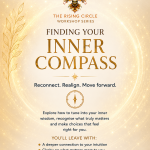
This workshop is a lovely space to reconnect with your inner voice, notice what has been buried beneath overwhelm, and begin rebuilding trust in your own needs, desires, and direction.