
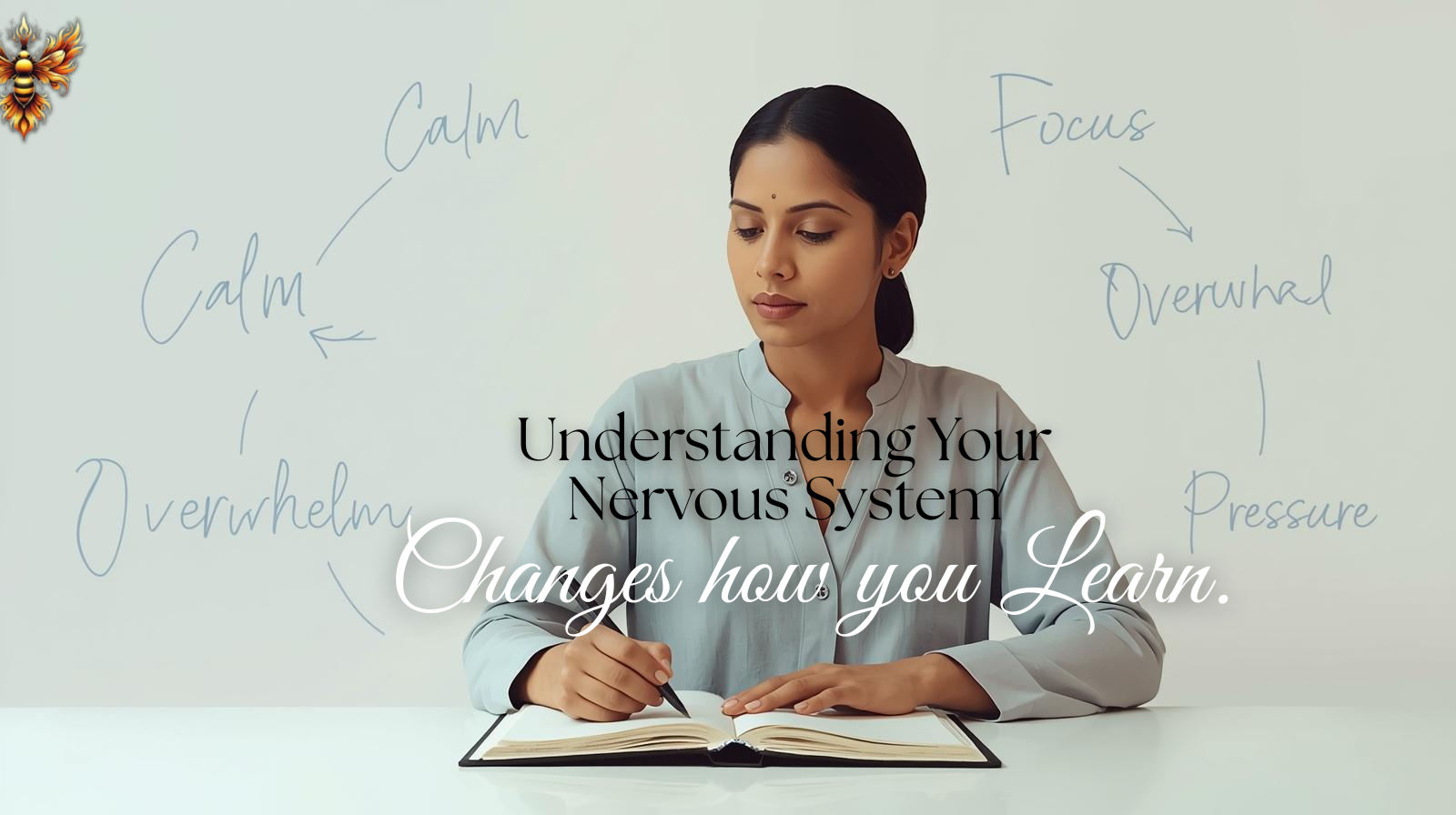
How Your Nervous System Affects Learning
Have you ever sat down to study or concentrate — and found your mind simply wouldn’t cooperate?
You read the same paragraph three times.
Your thoughts wander.
Your body feels restless or tired.
It’s easy in those moments to assume something is wrong with you.
Maybe I’ve lost my focus.
Maybe my memory isn’t what it used to be.
Maybe I’m just not cut out for this.
But what’s often happening has nothing to do with intelligence.
It has everything to do with yournervous system.
Your nervous system constantly scans your environment, asking one simple question:
Am I safe right now?
When the answer is yes, your brain opens up to learning, creativity, and problem solving.
But when your nervous system senses pressure, overwhelm, or threat — even subtle emotional stress — it shifts into survival mode.
And survival mode isn’t designed for learning.
Common Challenges
When our nervous system is under strain, learning becomes much harder. You might notice:
Difficulty concentrating.
Your mind jumps between thoughts or struggles to stay on one task.
Memory struggles.
Information doesn’t seem to stick the way you expect.
Emotional frustration.
You feel irritated with yourself or discouraged quickly.
Mental fatigue.
Even short periods of study feel draining.
These responses aren’t signs of failure.
They’re signals that your nervous system may be overloaded.
How to Move Through It
Create safety before productivity.
Take a few moments to breathe, stretch, or step outside before beginning a study session.
Work in shorter cycles.
Your brain absorbs information better in focused bursts with breaks in between.
Reduce pressure.
Approach learning with curiosity rather than urgency.
Pay attention to your body.
Hydration, sleep, and movement all affect how well your brain processes information.
Learning works best when the body feels supported.
Reflection Prompt
✨ When do you notice learning feeling easiest for you?
✨ And what conditions help your mind feel calm, focused, and curious?
Your answers may reveal more than you realise about how your nervous system likes to learn.
When we understand how our brain and body work together, learning becomes far less intimidating.
Instead of forcing ourselves through exhaustion or pressure, we can create environments where focus naturally emerges.
This approach sits at the heart of ourLearn2Learn program, which combines neuroscience, nervous system awareness, and practical study strategies.
Because learning isn’t just about information.
It’s about creating the conditions where your mind canactually receive it.
And when those conditions are right, learning becomes far more natural — and even enjoyable.