
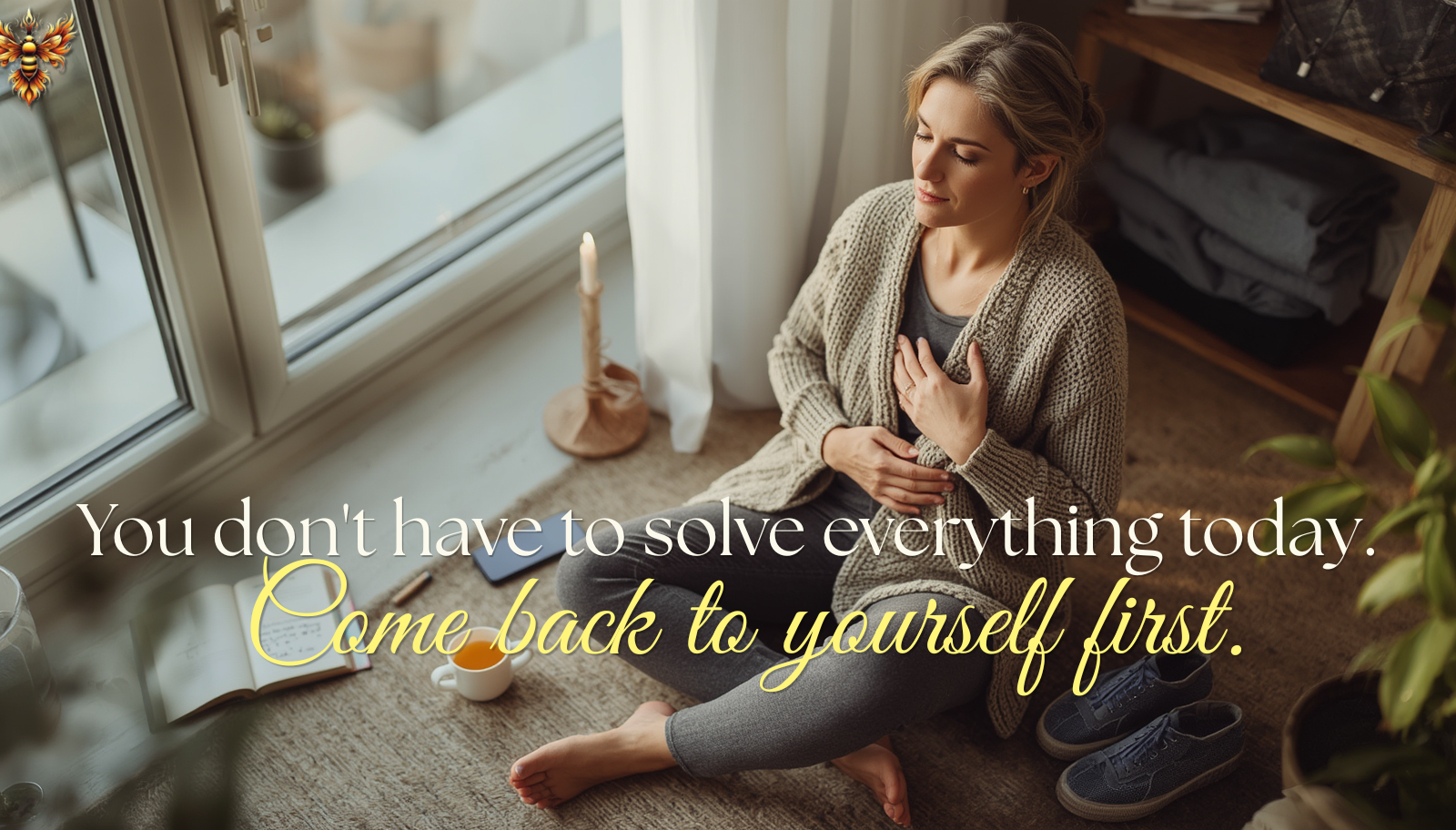
There are times in life where everything feels so loud.The calendar is full. The responsibilities keep coming. The needs of everyone around you feel urgent. Your mind is racing ahead, your body is bracing, and even when you finally get a moment to stop, you may not know how to actually rest.
You might look around and think,How did I get here?
Not because anything is necessarily “wrong” from the outside. Maybe you are still showing up. Still caring. Still working. Still doing what needs to be done.But inside, it can feel like chaos.
- The kind of chaos that makes it hard to hear yourself.
- The kind that turns every small decision into another thing to manage.
- The kind that leaves you craving change, but too exhausted to know where to begin.
And if that is where you have been, I want to say this gently: the first step back to yourself, to reconnecting with who you actually are is not always a big breakthrough.
Sometimes the first step is safety.Sometimes it is rest.Sometimes it is one small rhythm that helps your body remember,I am here. I can breathe. I do not have to solve everything all at once.
When chaos becomes familiar
When life has been overwhelming for a long time, chaos can start to feel normal.
You may become used to rushing. Used to scanning for what might go wrong. Used to carrying everyone else’s needs before your own. Used to pushing through, even when your body has been asking for a pause.For many women, this is not simply a matter of being “too busy.”It can be the result of years of responsibility, stress, caregiving, emotional labour, hormonal shifts, grief, trauma, over giving, or living in environments where slowing down did not feel safe or possible.
So when you finally decide you want something to change, it can be tempting to reach for the biggest transformation you can find.A new plan. A new routine. A new identity. A complete life overhaul.But if your system is already overloaded, more pressure may not create freedom. It may create more overwhelm.
This is why we begin with developing our roots.
- Not because you are fragile.
- Not because you are incapable.
But because sustainable change needs somewhere safe to land.
Before you rise, you root in
In our Rising Feminine Framework™, the first stage is about rooting and grounding.This is the place where we begin creating safety in the nervous system, establishing daily rhythms, making space to breathe, and allowing the body to experience small moments of balance again.
It is not the most glamorous stage of transformation!
It may not look dramatic from the outside.It might actually look like drinking water before coffee. Taking three slow breaths before opening your inbox. Going to bed ten minutes earlier. Sitting in the car for a moment before walking into the house. Saying, “I need a minute,” instead of forcing yourself to respond immediately.
Tiny things.But tiny things become signals.
- They tell your body:Someone is listening now.
- They tell your nervous system:We are not abandoning ourselves today.
- They tell the parts of you that have been rushing, bracing, pleasing, fixing, or holding it all together:You do not have to carry this alone in the same way anymore.
Rooting is not about getting everything perfect.It is about beginning to create a calm foundation so that you can actually hear yourself again.
You are not meant to heal in one prescribed way
One of the most compassionate things we can remember is that not every woman comes back to herself in the same way.
- Some women need movement before stillness.
- Some need structure before softness.
- Some need to talk things through before they can feel clear.
- Some need emotional space, tears, quiet, and permission to feel what has been held in for too long.
This is why generic advice can feel so frustrating.
- “Just rest.”
- “Just journal.”
- “Just set a boundary.”
- “Just think positively.”
These things may be helpful for some people in some moments, but healing is not one-size-fits-all. The support that helps one woman feel calm may make another woman feel trapped, restless, exposed, or disconnected.
Your way back to yourself needs to honour the way you are built.It needs to consider how you carry stress, how you process emotion, how you respond to pressure, what helps you feel safe, and what kind of support your body can actually receive right now.This is not about labelling yourself.
It is about understanding yourself.Because when you understand your patterns with compassion, you can stop treating them as proof that you are failing and start seeing them as information.
Your patterns may have been protecting you
If you have been living in chaos, you may have developed ways of coping that once made sense.
- Maybe you became the one who takes action quickly because waiting felt unsafe.
- Maybe you became the organiser, the stabiliser, the one who keeps everything functioning.
- Maybe you learned to think through every possible outcome so you could feel prepared.
- Maybe you became deeply attuned to everyone else’s emotions because belonging once depended on it.
None of these patterns mean there is something wrong with you.
They may have been intelligent responses to what life asked of you.They may have helped you survive stressful times, relationships, family dynamics, work pressures, health changes, or moments when there simply was not enough support.But what once protected you may now be exhausting you.
And that is where the invitation begins.Not to shame the pattern.Not to force it away.But to ask yourself:
Is this still serving me?
Is there another way I could support myself now?
What would help me feel safe enough to choose differently?
The first step does not need to impress anyone.It only needs to be honest enough that some part of you begins to trust you again.
Calm is not the absence of challenge
Sometimes we imagine calm as a life where nothing difficult happens.No conflict, no pressure, no responsibilities, no emotional waves and no unexpected changes.But real calm is not about controlling life so perfectly that nothing ever touches us.
Real calm is a relationship with ourselves.
- It is the ability to notice what is happening inside us without immediately abandoning ourselves.
- It is the capacity to pause, even briefly.
- It is the experience of having tools, rhythms, support, and language for what we feel.
- It is knowing that even when life gets loud, there is still a way to return.
This is the deeper work of rooting.
Not creating a perfect life. But creating a calmer, more consistent inner home.
A starting practice: the one-degree shift
If life has felt chaotic, try not to ask, “How do I fix everything?”
Ask instead:
What would help me feel one degree more supported today?
Trick - One degree is small enough that your system does not have to fight it.
It might be:
- drinking a glass of water
- stepping outside for two minutes
- cancelling something non-essential
- asking for help with one task
- writing down what is swirling in your mind
- eating something nourishing
- lying on the floor and breathing
- sending the message you have been avoiding
- choosing not to explain yourself this time
- letting one thing be unfinished
This is not about doing all of it.
It is about choosing one thing that says,I am allowed to be supported too.
Coming back to yourself is a practice
This sort of change is rarely a straight line.Some days you will feel clear and grounded.Other days you may fall back into old patterns.That does not mean you have failed, it means you are human. We are all on a similar journey of ups and downs.
Rooting takes repetition. Safety takes practice. New rhythms take time. Your body may need to experience, again and again, that you are allowed to slow down, allowed to have needs, allowed to receive, allowed to choose differently.
This is how change becomes sustainable:Through relationship with yourself, through listening to our bodies, and through small steps towards feeling calmer.
Reflection prompts
If you would like to take this deeper, you might gently reflect on:
- Where in my life have I been living in chaos or constant urgency?
- What does my body do when I feel overwhelmed?
- What kind of support actually helps me feel safer, calmer, or more steady?
- What is one small rhythm I could begin this week?
- What would help me feel one degree more supported today?
Next steps
If you are curious about the way you personally carry and release stress, ourStress Style Quiz can help you begin to understand what kind of support may feel most natural for your system.
And if you would like ongoing support, reflection, and wellbeing prompts, you may also love exploringRising Circle — our workshops and membership space for women who are ready to reconnect with themselves in a grounded, compassionate way.