
There is a particular kind of tiredness that comes from always being “on.” It is not only physical busyness, although that may be part of it. It is also the emotional alertness, mental fullness, and constant scanning that comes from planning, remembering, responding, anticipating, holding, and preparing all the time.
You may be sitting still, but inside you are still working. You may have a moment to rest, but your body does not know how to receive it. You may finally lie down and find your mind listing everything you have not done.
For many women, rest has become something they feel they have to earn. Only after the house is tidy. Only after the emails are answered. Only after everyone else is settled. Only after the work is done. Only after they have proven they have done enough.
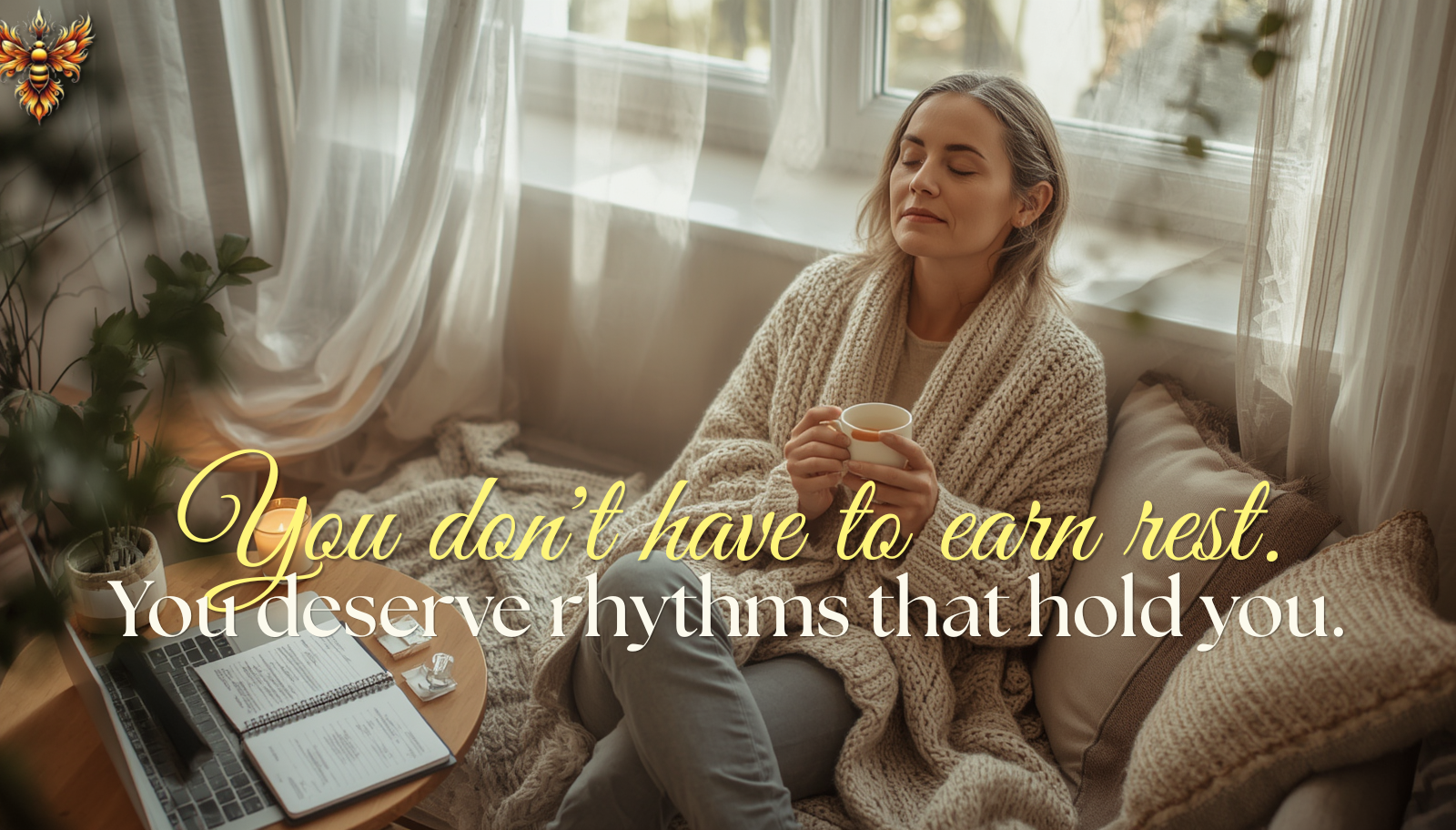
But rest is not a reward for productivity. Rest is part of how we stay connected to ourselves. For women who have been living in overwhelm, overgiving, stress, or survival mode, rest may need to become something more grounded than an occasional escape. It may need to become a rhythm that holds you.
Why rest can feel uncomfortable
If you have been pushing through for a long time, rest may not feel peaceful at first. It may feel strange, guilty, boring, vulnerable, or even unsafe. It may bring up everything you have been too busy to feel. It may make you aware of how tired you actually are.
This is why some women avoid slowing down, even when they desperately need it. Stillness can feel confronting when your body is used to momentum. Quiet can feel loud when your mind has been holding too much. Receiving can feel unfamiliar when you are used to being the one who gives.
If rest does not feel easy, try not to turn that into another reason to judge yourself. It may simply mean your body is learning something new.
Rest is not one thing
When we hear the word rest, we often imagine doing nothing: taking a nap, having a day off, lying in a quiet room, or taking a bath. These can be beautiful forms of rest, but rest is not only stillness.
Rest can also be relief. Rest can be rhythm. Rest can be knowing what comes next. Rest can be permission to stop performing. Rest can be a boundary. Rest can be a walk that lets your body release the day. Rest can be eating before you are depleted. Rest can be ten minutes without input. Rest can be not explaining yourself. Rest can be letting something be unfinished.
Rest is anything that helps your system stop bracing. Because every woman carries stress differently, rest will not look the same for everyone.
Daily rhythms create safety
When life feels chaotic, your system may crave something predictable. Not a rigid routine that becomes another standard to fail, and not a perfect morning ritual that only works in an imaginary version of your life. What you may need is a rhythm: a small, repeatable signal that says, “I am here. There is something I can return to.”
Rhythms are different from rules. Rules are often harsh. They say, “If I do not do this perfectly, I have failed.” Rhythms are supportive. They say, “This helps me come back.”
A rhythm can bend. It can be simple. It can meet you in the real life you are actually living. It may be three breaths before getting out of bed, a glass of water beside your coffee, a ten-minute reset after work, lighting a candle before dinner, putting your phone away for the first few minutes of the morning, or stepping outside before you start caring for everyone else.
The power is not in how impressive it looks. The power is in the repetition. Repetition teaches your body that there are places where you are allowed to return to yourself.
The rhythm beneath the routine
Many women have tried routines that did not last. A new planner, a morning routine, a health plan, a strict schedule, or a promise to wake up earlier and become an entirely different person by Monday.
When the routine collapses, they feel like they have failed. But often the problem was not the woman. It was that the routine did not honour her actual capacity. It did not consider her life, energy, stress load, responsibilities, hormones, nervous system, or the kind of support she actually needed.
A rhythm is not about forcing yourself into an ideal. It is about finding the smallest supportive pattern that helps you feel more held. Instead of asking, “What should my routine look like?” ask, “What rhythm would help my body trust the day a little more?”
Three kinds of rhythms that can hold you
If you are beginning again, it may help to think in three simple categories: opening rhythms, transition rhythms, and closing rhythms. You do not need all three at once. You can begin with one.
An opening rhythm helps you enter the day without immediately abandoning yourself. It might be placing your feet on the floor and taking one slow breath, drinking water before checking your phone, opening a window, stretching your neck and shoulders, choosing one word for the day, or asking, “What do I need to remember today?”
A transition rhythm helps you move between roles, responsibilities, and spaces. Many women lose themselves in transitions: moving from work to home, from caring for children to answering messages, from being with people to being alone, or from one demand straight into the next. A transition rhythm might be sitting in the car for two minutes before going inside, washing your hands slowly after work, changing clothes, playing one song between roles, or placing a hand on your chest and saying, “I am here now.”
A closing rhythm helps your body understand that the day is allowed to end. It might be writing down tomorrow’s tasks so they are not circling in your mind, dimming the lights, making a cup of tea, putting your phone away, stretching on the floor, reading one page, or asking, “What can be left unfinished tonight?”
None of these need to be elaborate. They simply help your body register that you are moving through life with more care.
You do not have to wait until everything is done
One of the biggest lies many women inherit is that rest comes after everything else. After the work, after the care, after the cleaning, after the messages, after the emotional labour, after the proving.
But there will always be more to do, hold, remember, and respond to. If rest only comes when everything is finished, rest may never come. This is why rest has to become part of the rhythm, not the prize at the end.
This does not mean abandoning responsibility. Rest helps you carry responsibility in a more sustainable way. A rested woman is not necessarily a woman with no demands. She may still have work, family, caregiving, relationships, bills, appointments, grief, health issues, and full days. But she is learning to include herself in the system of care.
Rest is not opting out of life. It is returning to life with more of yourself available.
A gentle practice
If you are not sure where to begin, try a simple rhythm audit. Ask yourself: Where does my day feel most chaotic? Where do I regularly abandon myself? Where do I move too quickly without breathing? Where do I feel resentful, rushed, or unseen? Where might one small rhythm help me feel more held?
Choose one place. Not the whole day. Not the whole life. One place. Then ask, “What is the smallest supportive action I could repeat there?”
Make it almost too easy. A breath. A glass of water. A note on the bench. A five-minute pause. A sentence. A song. A hand on your heart. A moment where you remember, “I am here too.”
Next steps
If you are ready to create more supportive rhythms without turning them into another pressure,Rising Circle offers wellbeing prompts, live sessions, and ongoing reflection for women who want to reconnect with themselves in a grounded and sustainable way.
https://wisdome.site/checkout/6a06a8f8a7600ce742c2210a/monthly